Part 2 — The Man Who Counted His World
Before Echo, my apartment contained exactly what I needed.
A bed with one side against the wall.
A round kitchen table so I would not strike sharp corners.
Raised dots on the microwave, washing machine, and thermostat.
Rubber bands around canned soup, textured stickers on vegetables, and a talking scale near the bathroom.
My wife, Ruth, helped design that system while I was losing my sight.
She died two years after the infection took what little vision remained.
Cancer moved faster than my adjustment to blindness.
VisionCare
After she died, I reduced the apartment again.
One chair at the table.
One coffee mug in the dish rack.
Discover more
leash
Doors & Windows
doors
One towel on the bathroom rail.
People praised my independence because praise was easier than asking whether independence had become isolation.
I belonged to an orientation-and-mobility program. I navigated with a white cane and used accessible transit. I prepared meals, managed medication, and attended appointments without a caretaker.
Still, I sometimes went three days without touching another living thing.
My daughter, Anna, lived in Seattle and called each evening. She offered repeatedly to move me closer.
I refused.
I told her Portland was home.
The truer answer was that I feared becoming another item inside her busy life that needed scheduling.
Echo entered surgery the evening I found him.
The veterinary team repaired damage around his left hip and stabilized his pelvis. A deep cut near his rear paw required cleaning and sutures. He had been underweight before the collision, which complicated recovery.
His blindness was permanent.
The cataracts explained the cloudy eyes, but retinal degeneration meant removing them would not return meaningful sight. Treatment could reduce inflammation and keep him comfortable.
Discover more
Pets
Anatomy
Bed
The clinic estimated his age at seven.
He was a Labrador–pit bull mix, black with a white chest, one folded ear, and a narrow patch of silver beneath his lower lip.
No person claimed him during the legally required holding period.
I visited every day.
At first, Echo recognized me through the wool scarf. I placed it near his enclosure before speaking. By the fourth day, the scarf was unnecessary.
He knew my footsteps.
My cane tapped the hallway tile in a pattern different from wheeled carts and veterinary shoes. When I stopped outside his kennel, his nose moved toward the bars.
I used two taps before reaching for him.
Tap.
Tap.
Then touch.
Echo learned the sequence.
Discover more
dog
bed
Beds
I learned his.
One breath when relaxed.
BiologicalSciences
A low huff when uncertain.
Three rapid sniffs when another animal passed.
His folded ear moved less than the upright one, so I approached from the right whenever possible.
We built recognition without eye contact.
The clinic behaviorist warned me against turning coincidence into a plan too quickly.
A blind dog required management.
A blind older adult living alone faced different risks.
My cane could accidentally strike him. Echo could block a narrow hallway. Stairs, traffic, dropped medication, and emergency evacuation required preparation.
Affection would not solve those problems.
Planning might.
Discover more
Pets & Animals
Beds & Headboards
Door
I applied to foster him only after the clinic arranged an evaluation with a guide-dog mobility specialist, a veterinary behaviorist, and my own orientation instructor.
They asked whether I expected Echo to guide me.
“No.”
Whether I would stop using my cane.
“No.”
Whether I understood that a pet dog—even one with a strong nose—was not a trained guide dog.
Pets
“Yes.”
“What do you expect from him?” the behaviorist asked.
I thought about the hedge.
“Company that understands why furniture stays where it belongs.”
Part 3 — Learning the Apartment by Sound and Scent
Echo came home on January 9.
We prepared before he arrived.
Discover more
Disabled & Special Needs
Gardening
pet
My orientation instructor, Denise Walker, helped mark safe walking lanes through the apartment. We moved nothing essential from its long-established position. Foam guards covered two low furniture edges. Baby gates blocked the kitchen during meal preparation and the building stairwell when my door opened.
Different textured mats identified locations.
Ribbed rubber at the entrance.
Soft woven fabric beside Echo’s bed.
A rough square beneath his water bowl.
A smooth mat near the balcony door.
Each area also carried a consistent scent placed high enough that Echo could smell but not lick it: lavender near his bed, cedar near the door, and a faint vanilla marker near the water station.
We did not fill the home with strong odors. A dog’s nose needed contrast, not confusion.
Dogs
Echo entered on a short leash attached to a well-fitted harness.
He stopped at the threshold.
His nose moved from left to right.
I tapped the ribbed mat twice.
Discover more
Vision Care
Biological Sciences
Dogs
He stepped forward.
The apartment was new to him but familiar to me. For the first time since losing my sight, I became the person who knew exactly where everything was.
I led Echo along the walls.
Seven steps to the living room.
Turn right at the rug.
Five steps to the water.
Pause before the table.
I used words, taps, and gentle leash guidance. He moved slowly, touching furniture with his whiskers before committing his body.
At the bedroom, Echo bumped the door frame.
He froze.
I touched the same frame with my palm.
“Door.”
Discover more
Running & Walking
Pet Leashes
Music & Audio
He smelled my fingers, then the wood.
On the return trip, he avoided it.
That first night, Echo refused the orthopedic bed. He lay on the ribbed entrance mat facing the door.
Beds& Headboards
I understood.
The doorway had been his last known exit from every uncertain place.
I brought my pillow into the hall and slept several feet away.
Near 3 a.m., Echo crossed the space between us. His nails clicked twice on the floor, then stopped.
His nose touched my forehead.
He returned to the mat.
It was enough.
Our difficulties began the next morning.
Echo stood silently behind me while I backed away from the counter. My leg struck his shoulder, and we both fell.
https://googleads.g.doubleclick.net/pagead/ads?gdpr=0&us_privacy=1—&gpp_sid=-1&client=ca-pub-1051383305043949&output=html&h=280&slotname=9046974799&adk=3675038965&adf=3603401776&pi=t.ma~as.9046974799&abgtt=6&w=1106&fwrn=4&fwrnh=100&lmt=1784310012&rafmt=1&format=1106×280&url=https%3A%2F%2Fcaygamevn.com%2Fa-blind-widower-heard-a-wounded-dog-breathing-inside-a-hedge-then-his-hands-discovered-the-animal-could-not-see-him-either%2F&fwr=0&fwrattr=true&rpe=1&resp_fmts=3&aiof=10&asro=0&aimartd=4&aieuf=1&aicrs=1&uach=WyJXaW5kb3dzIiwiMTAuMC4wIiwieDg2IiwiIiwiMTUwLjAuNzg3MS4xMTYiLG51bGwsMCxudWxsLCI2NCIsW1siTm90O0E9QnJhbmQiLCI4LjAuMC4wIl0sWyJDaHJvbWl1bSIsIjE1MC4wLjc4NzEuMTE2Il0sWyJHb29nbGUgQ2hyb21lIiwiMTUwLjAuNzg3MS4xMTYiXV0sMF0.&dt=1784309950715&bpp=1&bdt=1633&idt=252&shv=r20260716&mjsv=m202607140101&ptt=9&saldr=aa&abxe=1&cookie=ID%3Dc484377c35b3cd06%3AT%3D1784170371%3ART%3D1784307043%3AS%3DALNI_Mag4ztcLnhCXTH2vb56AsBibsLUJw&gpic=UID%3D0000144165a9a07a%3AT%3D1784170371%3ART%3D1784307043%3AS%3DALNI_MbpNHABB2-eUdgOcP4Y84-N3neJfw&eo_id_str=ID%3D46bd1fa1c05fc7b6%3AT%3D1784170371%3ART%3D1784307043%3AS%3DAA-AfjaRw7Wkup7U63r_RMn_HQX1&prev_fmts=0x0%2C1106x280%2C1106x280%2C1106x280%2C1106x280%2C1106x280%2C1106x280%2C1106x280%2C1106x280&nras=1&correlator=1904779881474&frm=20&pv=1&u_tz=300&u_his=1&u_h=768&u_w=1366&u_ah=728&u_aw=1366&u_cd=24&u_sd=0.5&dmc=8&adx=798&ady=10586&biw=2702&bih=1282&scr_x=0&scr_y=5498&eid=95396104%2C95396568%2C42533293%2C95391230%2C95396252&oid=2&pvsid=6931323000256008&tmod=731476957&uas=3&nvt=1&ref=https%3A%2F%2Fl.facebook.com%2F&fc=1920&brdim=0%2C0%2C0%2C0%2C1366%2C0%2C1366%2C728%2C2732%2C1282&vis=1&rsz=%7C%7CoeEbr%7C&abl=CS&pfx=0&fu=128&bc=31&bz=0.5&pgls=CAEaBTcuMC4x&ifi=10&uci=a!a&btvi=8&fsb=1&dtd=62046
Neither was injured.
Both became frightened.
Denise changed our system.
I wore a small bell attached to my belt while working in the kitchen so Echo could track me. Echo wore a soft tag producing a quieter tone, allowing me to hear where he stood. The bells were removed during rest and never used outdoors as substitutes for leash control.
We taught a word for position.
“Clear.”
When I said it, Echo moved toward his textured bed.
Beds& Headboards
When he needed to pass, I tapped my cane twice against the floor and waited for his tag to move.
Within three weeks, collisions became rare.
Echo learned the elevator by its vibration and chime. He disliked the first trip, flattening his body when the doors closed. I stood beside him and rested one hand on his harness.
“I don’t like elevators either.”
At the lobby, he smelled the cedar marker attached near the inner doorway. Outside, Denise walked with us during every early trip.
Discover more
Pet Food & Pet Care Supplies
How-To, DIY & Expert Content
Book
I continued using my cane.
Echo walked on my left, slightly behind my knee, not in a guide position. I located curbs and obstacles. He followed my pace.
Sometimes he smelled an open trash bin or food on the pavement and drifted toward it.
He was a dog.
Not equipment.
The distinction protected both of us.
Part 4 — The First Time Echo Stopped Me
Echo’s strength returned gradually.
His pelvis healed, though his left rear leg remained stiff after long walks. The veterinary team prescribed controlled exercise, medication, and physical therapy.
I learned to check his gait through sound.
Four regular nail taps meant he was moving comfortably.
A shortened third beat meant the left leg had tightened.
On wet mornings, I shortened our route.
Discover more
Missing Persons & Abductions
Visual Art & Design
Veterinarian
Echo learned my changes too.
When my cane struck an object, he paused instead of walking into my legs. When an audible traffic signal sounded, he oriented toward the curb but waited for my command.
Running& Walking
Three months after adoption, we encountered road construction near our usual crossing.
The pedestrian signal activated.
I listened to traffic, confirmed the crossing direction, and moved forward.
Echo stopped.
The leash tightened gently behind me.
I assumed he had smelled food.
“Come.”
He remained.
I extended my cane.
The tip found no pavement where pavement should have been.
Discover more
Veterinarians
Educational Resources
Language Resources
Construction workers had opened a narrow trench near the curb ramp and failed to replace the temporary barrier after moving equipment.
My cane would probably have found it before I stepped fully forward.
Echo found it first through scent, air movement, or the altered sound of the space.
He had not become my guide dog.
He had given me additional information.
I backed away and reported the hazard.
The construction company corrected it within an hour.
News of the incident spread after a nearby shopkeeper described it to a neighborhood reporter. The resulting article called Echo “The Blind Dog Who Guides a Blind Man.”
VisionCare
I disliked the title.
It erased the training, cane, traffic skills, and safety systems supporting our independence. It also placed a job on Echo he had never been trained to perform.
I asked the reporter to correct it.
The second title read:
Discover more
Samples & Sound Libraries
Biological Sciences
Anatomy
Blind Neighbors Learn a City Together
Better.
The article led to invitations for interviews and public events. We declined most.
Echo disliked applause, crowded rooms, and people reaching without warning. Inspiration did not require making him uncomfortable.
We agreed to one small presentation at a local accessibility center.
Denise explained our systems:
- consistent furniture placement;
- textured landmarks;
- sound cues;
- short controlled walks;
- veterinary care;
- orientation training;
- and recognition that Echo was a companion, not a mobility device.
I spoke about the hedge.
Gardening
A woman in the audience asked whether Echo had restored my independence.
“No,” I said. “I had independence before him.”
The room became quiet.
“He restored company.”
Echo lay beneath my chair, one folded ear against my shoe.
Discover more
Animal Welfare
door
Running & Walking
That answer mattered more.
Blindness was not the tragedy in our story.
Being unheard was.
Part 5 — When My Ears Failed Him
Six months after Echo came home, an ear infection reduced my hearing temporarily.
I woke one morning with pressure in my right ear and a low ringing that distorted nearby sounds. My left ear already carried age-related loss.
Suddenly, Echo’s soft tag became difficult to locate.
I felt the old fear return.
Sight had disappeared over years. Hearing changed overnight.
https://syndicatedsearch.goog/afs/ads?sjk=4T7b7%2BNJTze5b%2ByOvAWQSg%3D%3D&psid=5134551505&channel=AutoRsVariant&cx=r-1664d76bcadc2fae4&fexp=95396104%2C95396568%2C42533293%2C95391230%2C95396252%2C21404%2C17301431%2C17301432%2C17301436%2C17301266%2C72717107%2C17301575&client=pub-1051383305043949&r=m&sct=ID%3De11b82ff10a4ee1e%3AT%3D1784128156%3ART%3D1784128156%3AS%3DALNI_MbDDIEv2FVmA7zqZCSmwa3S5740tg&sc_status=6&hl=en&rpbu=http%3A%2F%2Fgoogle.com&rpqp=q&type=3&rs_tt=c&oe=UTF-8&ie=UTF-8&format=r5&nocache=1291784309953053&num=0&output=afd_ads&domain_name=caygamevn.com&v=3&bsl=10&pac=0&u_his=1&u_tz=300&dt=1784309953053&u_w=1366&u_h=768&biw=2702&bih=1282&psw=2702&psh=32755&frm=0&uio=-&cont=autors-container-0&drt=0&jsid=csa&oc=1&jsv=947067704&rurl=https%3A%2F%2Fcaygamevn.com%2Fa-blind-widower-heard-a-wounded-dog-breathing-inside-a-hedge-then-his-hands-discovered-the-animal-could-not-see-him-either%2F&referer=https%3A%2F%2Fl.facebook.com%2F&lle=1
Without either, my apartment seemed larger and less stable.
Anna offered to fly down.
I told her not to.
That refusal lasted three hours.
Discover more
Vision Care
Beds
Disabled & Special Needs
Then I stepped backward in the bedroom and nearly tripped over Echo because I had not heard him approach.
I called Denise.
She arrived with an updated plan.
Echo’s tag received a slightly stronger but still comfortable tone during waking hours. I wore a wrist device that vibrated when a small indoor sensor detected him approaching within several feet. We added a tactile cue: Echo learned to touch his nose to the back of my hand before moving across my path.
Anatomy
Most importantly, I accepted temporary help.
Caleb, the teenage neighbor, handled longer walks.
Anna came for the weekend anyway.
She had not visited since Echo’s adoption. At first, she treated him like an obstacle inside a small apartment. She worried about falls, medical emergencies, and the responsibilities I had accepted at seventy-eight.
Echo kept his distance from her.
On the second evening, Anna sat at the kitchen table and said what she had avoided during telephone calls.
“I thought you adopted him because you were giving up.”
“On what?”
Discover more
Vet
Pets
Music & Audio
“Living alone. Managing. I thought maybe this was the beginning of everything becoming too much.”
Echo approached my chair and pressed his nose to the back of my hand—the cue we had just taught him.
I moved my feet.
He crossed safely.
“Does that look like giving up?”
Anna exhaled.
“No.”
“It looks complicated,” I said. “Complicated isn’t the same as impossible.”
The following morning, Anna accompanied us outside. She watched me locate the curb with my cane while Echo waited beside my leg. She saw him stop at a bicycle left across the sidewalk and heard me identify it before moving around.
Neither of us performed the whole task.
Information moved between us.
My cane found hard edges.
Discover more
Dogs
pet
Pet Food & Pet Care Supplies
Echo detected scent, movement, and changes ahead.
I listened for traffic.
He listened for my voice.
When the ear infection cleared, I retained the nose-touch cue. Redundancy made systems safer.
Anna began visiting every two months.
Echo eventually learned her footsteps.
When she entered, his tail struck the floor twice.
She stopped asking whether he made my life harder.
All relationships do.
That is not the only measure of their worth.
Part 6 — The Route We Built Together
Echo and I walk every morning at 8:15.
Running& Walking
Our route covers six blocks.
Discover more
Gardening
Pets & Animals
Physics
We leave through the cedar-scented doorway, wait for the elevator chime, cross the lobby’s tile, and stop at the ribbed mat inside the building entrance.
Outside, I unfold my cane.
Echo’s leash clips to my waist only as a secondary safeguard while I hold it in my left hand. His harness does not resemble a guide-dog harness, preventing strangers from assuming he is working in that role.
We turn toward the bakery.
Echo smells it before I do.
At the first crossing, the audible signal identifies the phase. I confirm traffic patterns and locate the curb ramp with my cane.
Echo waits.
At the next block, he smells the planter where a neighborhood cat sometimes hides. His nose pulls right.
I say, “Forward.”
He sighs loudly enough to be theatrical.
We continue.
People recognize us now, but most have learned not to touch Echo without asking. A small card attached to my bag reads:
Discover more
Dictionaries & Encyclopedias
Door
Doors & Windows
Blind companion dog. Please speak before approaching.
VisionCare
The wording protects both of us.
Children often ask how two blind creatures know where to go.
I explain that we do not “see through each other.”
We share information.
I hear a bicycle bell before Echo reacts.
He smells another dog before I know it is near.
My cane identifies a curb.
His body warns me when an unusual surface changes beneath his paws.
We still make mistakes.
I once led us into the wrong elevator at a medical building.
Echo walked confidently into a janitor’s closet because it smelled like the cleaning products used in our lobby.
We both stood there for several seconds before I found the shelves with my cane.
I laughed until Echo sneezed.
A life does not become meaningful only when it appears heroic.
Much of ours is wrong doors, wet towels, medication schedules, and deciding whose fault it is when a dropped piece of toast disappears.
Doors& Windows
The community accessibility center created a workshop based partly on our experience. It helps disabled older adults evaluate pet adoption realistically, arrange support, adapt homes, and avoid assuming companionship must mean unsafe dependence.
Not everyone leaves with an animal.
Some decide the responsibility is too great.
That is a valid outcome.
Others discover that care can travel in more than one direction.
Echo requires medication, structured routes, veterinary appointments, and protection from hazards he cannot see.
I require accessible signals, a cane, occasional assistance, and people willing to describe changes in spaces.
Neither of us is independent in the absolute sense.
Nobody is.
We are simply honest about the systems holding us.
Part 7 — The Breath Beside Mine
Echo is ten now.
His black muzzle has turned silver around the edges, and the white patch on his chest has widened with age. His left rear leg remains stiff, so our six-block walk sometimes becomes four.
We do not apologize to anyone for turning home early.
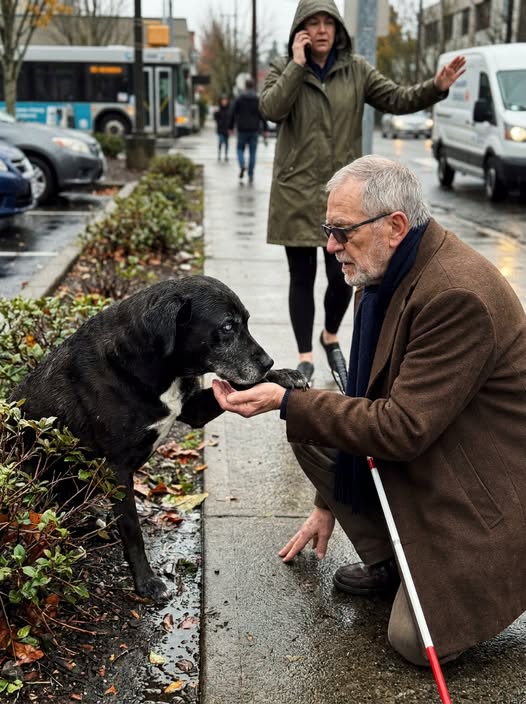
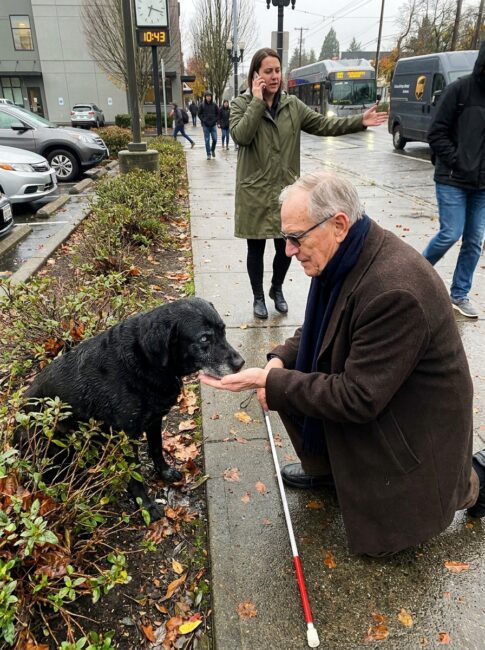
Each Tuesday at 10:43, we pass the hedge where I found him.
The property owner trimmed it back after the collision and installed a low barrier between the planting bed and parking lot. A small water bowl sits near the entrance during summer.
We stop there for one minute.
I tap the pavement twice.
Echo touches his nose to my wrist.
Then we continue.
People often repeat a sentence from our story: I did not see Echo, and Echo did not see me.
That is true.
The part that matters is what happened next.
I listened.
He smelled.
I reached.
He answered.
Darkness did not create our bond. Attention did.
Echo did not rescue me from blindness. I did not rescue him from his. Neither condition required a sentimental cure.
VisionCare
I helped him survive an injury and learn a safe home.
He helped me fill that home with another breathing body.
At night, Echo sleeps beside the bedroom threshold. I can hear his breathing across the room.
Long inhale.
Soft exhale.
A pause.
The same sequence that stopped me on the sidewalk years ago.
Sometimes I wake and listen until the next breath arrives. Echo raises his head when my bedsheets move and touches his nose to the mattress.
We check that the other is still there.
Then we sleep again.
My daughter no longer calls to ask whether I am lonely.
She asks what Echo stole from the kitchen.
Yesterday, it was half a banana.
He left the peel.
I found it with my cane before breakfast.
Two blind lives are not a perfect team because our limitations cancel each other. Life does not work like arithmetic.
We are a team because each of us notices what the other might miss—and because neither walks away when the route becomes complicated.
I found Echo through one broken breath beneath city traffic.
Years later, his breathing remains the sound that tells me I am home.