He didn’t touch me, not in the way I feared. Instead, Charles poured us both a drink, gestured for me to sit down, and spoke as if we were old friends trapped in a waiting room.
“I didn’t go by Charles Harwood,” he began. “My name was Gregory Humes. I worked as a cosmetic surgeon in Los Angeles for almost 30 years. And a very good one, too.”
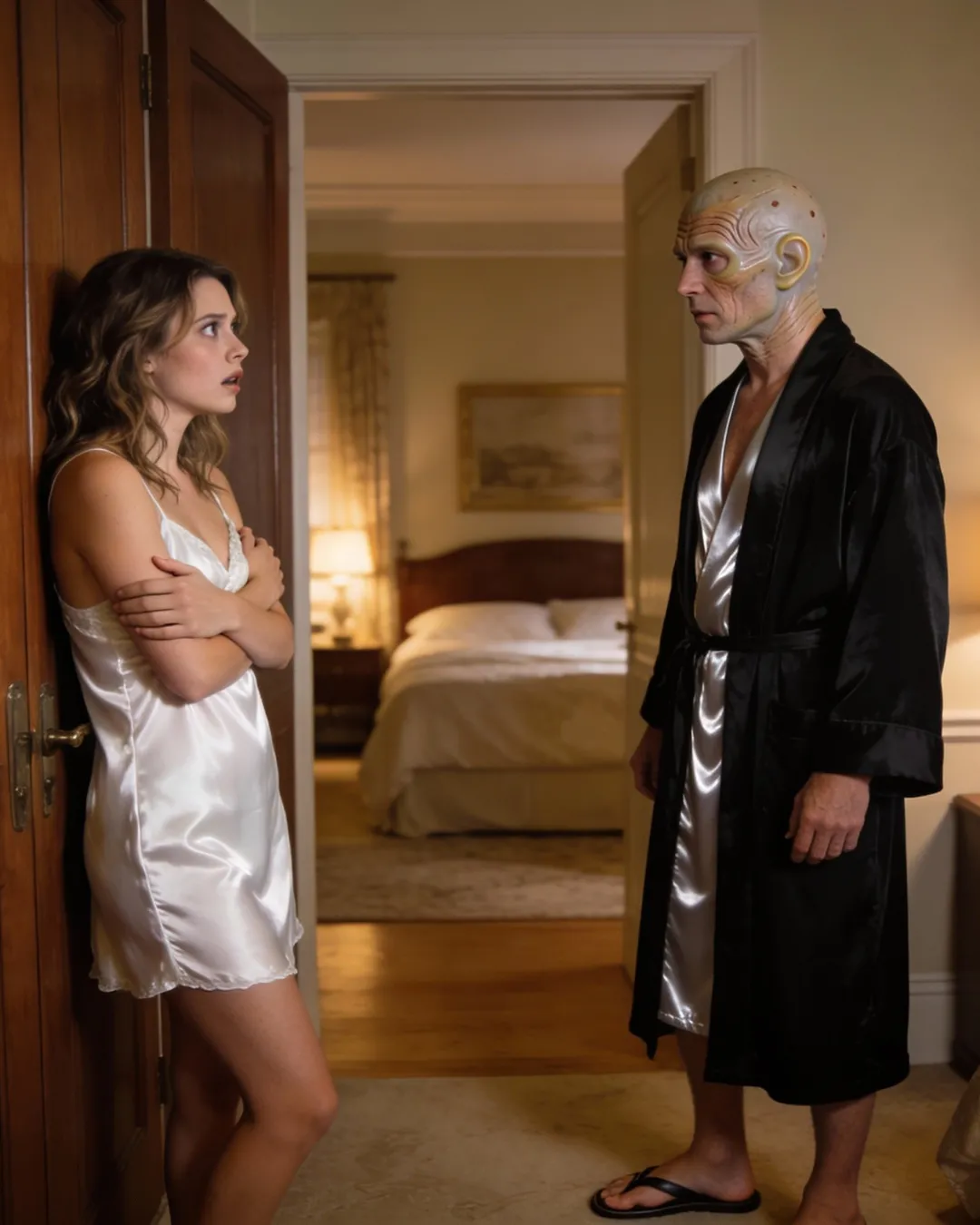
I sat rigidly in the chair facing him. I could barely see his face: how he moved, how he clung too tightly to inappropriate places. The lamp’s glare reflected the sheen of the synthetic skin, glued on with clinical precision.
I made a fortune in desperation. Actresses, executives, wives of senators… they came to me to become other people. And I paid well.
He took a sip of bourbo. “But I became greedy. Too greedy.”
It turns out that Charles—or Gregory—had developed an illegal side business. Through experimental surgeries, facial reconstruction, and synthetic implants, he helped criminals disappear, literally giving them new faces. He called it “erasure work.”
The FBI found out six years ago. They revoked his license. He faced 30 years in federal prison. But instead of serving his sentence, he reached an agreement.
He testified against high-profile clients—men who could exile governments—and in return, they gave him a new identity: Charles Harwood.
New name, new location, and a trust fund large enough to keep it secret and hidden.
“But the irony,” he said, laughing bitterly, “is that I had to become my own patient.
The government paid another surgeon to reconstruct my face so I would disappear forever. They used one of my own designs. That’s why it doesn’t move well. It’s not mine.”
I asked him why he needed a wife.

He remained silent for a while. Finally, he said, “Because money has its quirks. The trust is fully activated only if I legally marry within sixty-three years. It’s a clause that belonged to someone else, but I inherited it.”
I asked him why he chose me.
He looked me straight in the eyes. “Because you were desperate, and you said it sincerely. Without pretense. Without lies.”
I got up and left the room. He didn’t follow me.
The next morning, I found him in the garden, pruning rose bushes with latex drops. He was acting as if nothing had happened.
That became our pattern. We lived like ghosts in that house. No intimacy. No discussions. Just silence and expensive wine.
But five weeks later, everything changed when I received a letter from a woman named Iris Caldwell. The return address was Nevada.
The letter said:
You don’t know me, but I married Charles Harwood ten years ago. If you’re reading this, you’re in danger. She’s not who she claims to be. She lied to me too. And I barely escaped with my life.
Iris’s letter shattered the fragile acceptance I had begun to build.
It was handwritten, each line forcefully scrawled, as if someone had forced the words onto the page.
She wrote about her wedding to Charles—the same mask, the same secrecy, the same infidelity—but ten years earlier, with a different name: Michael Desmod
He had told her the same story. Ex-surgeon. Contract with the government. Hidden life.
“Uses different aliases,” the letter said. “And every marriage is a transaction. Mine ended after six months, when I decided to leave.”

The FBI file was sealed. But she had copied parts of it before fleeing.
“She’s not in witness protection,” she wrote. “She’s in hiding. And every woman she marries disappears.”
I confronted Charles that night.
He wasn’t bothered when I showed him the letter.
“I was wondering when you’d hear about her,” he said, calmly placing a bookmark in his novel. “Iris is alive, yes. She ran away. She took one hundred thousand dollars and disappeared. A smart woman.”
I asked him if what she wrote was true.
He sighed and looked married again. “A little.”
He admitted the aliases, the false identity. But the women?
“They weren’t victims,” he said coldly. “They were partners. We had agreements. And some couldn’t keep their end of the bargain.”
I asked what happened to them.
He didn’t answer.
That night, I searched his studio. I found a floorboard that had given way under pressure. Underneath it, a safe. Inside were IDs—driver’s licenses, passports, credit cards—all women’s. Five names. Five faces.
And a scalpel.
The next morning, I packed my suitcase and tried to leave. The gates of the complex were closed. The conductor wasn’t there. My phone had no signal.
Charles met me in the lobby.
“You broke the contract,” he said simply.
He didn’t yell. He didn’t hit anything. He just looked… disappointed.

But I had already anticipated this. I had sent photos of the IDs to a friend in Charleston, with the promise to forward them to the police if I didn’t turn myself in within 48 hours.
Charles stared at me when I told him.
Then, unexpectedly, he smiled. “How inglorious, Leah.”
I left the house that afternoon. A car was waiting for me.
Two weeks later, federal agents raided the property. Charles Harwood—or Gregory, or Michael, or whatever his real name was—had disappeared. The bank was empty the night I left.
I never found him.
But sometimes, I still receive letters. Yes, return address. Just a white envelope, and inside, a pressed rose. Always with the same note:
“Well played.”